
What Do I Tell My Parents When They Ask “When Are You Getting Married?”
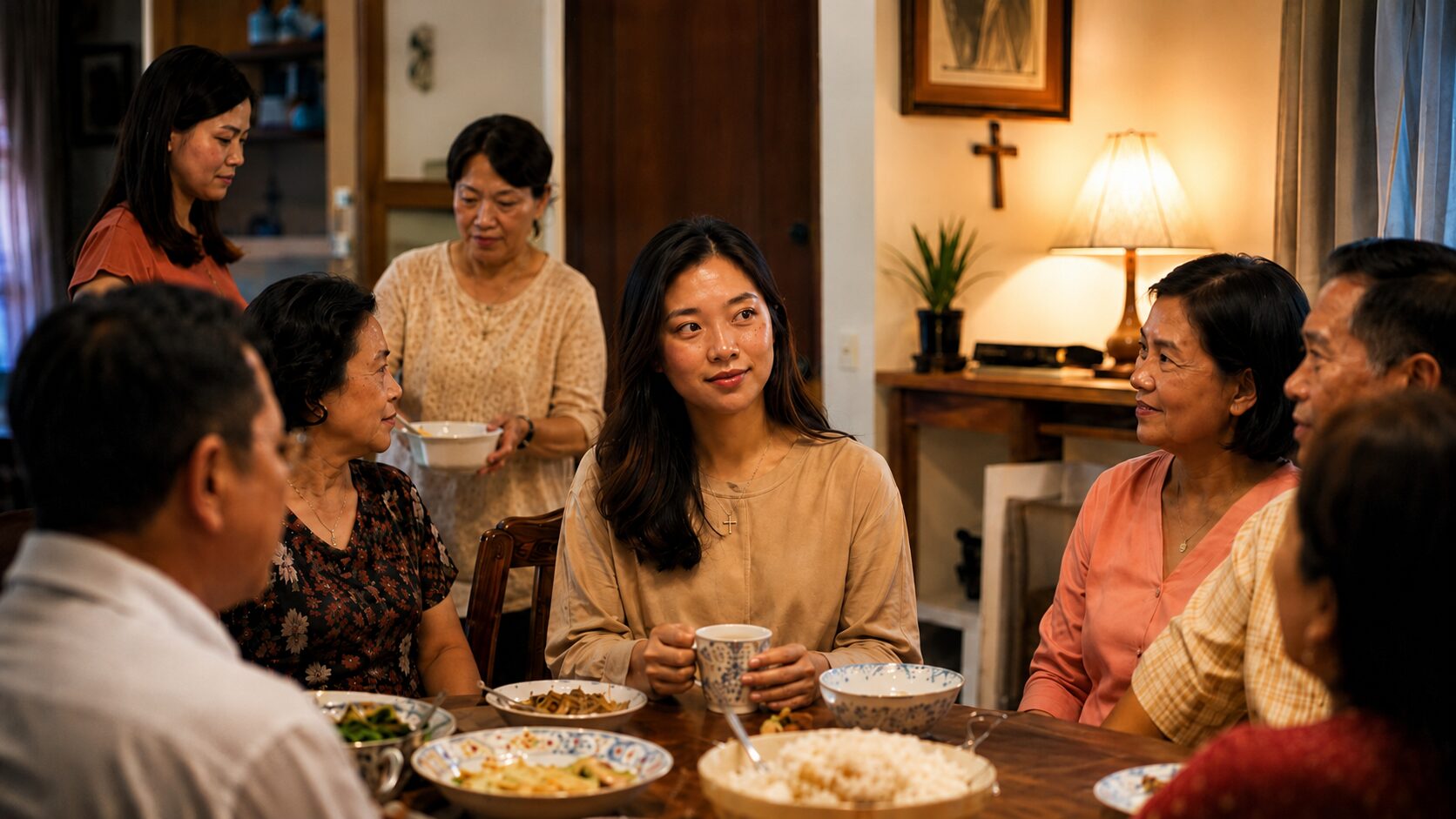
Malaysians know this ritual well. Chinese New Year even has an informal name for it, the “20 questions”, where marriage status gets asked alongside your exam results and your salary, all before the second cup of tea. An auntie leans over at the reunion dinner table. Or it’s your father, quieter but no less pointed. “So… when are you getting married?” You smile. You deflect. If you’ve never quite known what to say when you’re asked about marriage, you’re not alone and there’s a better answer than the one you’ve been rehearsing.
Short answer: You don’t owe anyone a timeline. A steady “I’m trusting God’s timing, and I’m genuinely okay” is a complete answer. Ecclesiastes 3:1 reminds us there’s a season for everything, including this one.
This isn’t a list of clever comebacks. It’s a walk through why this particular question lands so hard, whether it’s actually wrong to still want marriage, how to respond without lying or shutting the conversation down, and what to do with the anxiety it stirs up. None of it requires you to have your future figured out.
Why Does This One Question Feel So Loaded?
It isn’t limited to one festive season, either. Whether it’s a Chinese New Year reunion dinner, a regular family dinner, or a Deepavali visit, marriage status gets treated less like a personal milestone and more like a public scoreboard everyone’s allowed to check. Underneath that scoreboard sits an assumption nobody says out loud: that if you haven’t married yet, something must be wrong, with your effort, your standards, or you. That assumption is what actually stings and it’s worth naming, since assumptions we don’t name tend to run our lives quietly in the background.
Scripture actually challenges that assumption directly. Ecclesiastes 3:1 and 11 says: “There is a time for everything, and a season for every activity under the heavens… He has made everything beautiful in its time.” Solomon wrote this near the end of a long life spent testing what makes existence meaningful, concluding that human effort doesn’t control timing, God does. For you, that means your unmarried season isn’t proof you’re doing life wrong. It’s simply a chapter still being written, on a timeline you were never meant to control.
Mark Vroegop, president of The Gospel Coalition, wrote about this exact tension after years of hating to wait himself. He named three unhelpful ways people respond to delay anger, anxiety, and apathy, before landing on this: “While I wait, I can focus on his trustworthiness, not on my expected timing.” That’s the shift your auntie’s question is really inviting, even if she doesn’t know it.
Is It Wrong to Still Want to Get Married?
No and the numbers back this up. A 2026 survey by Malaysia’s National Population and Family Development Board (LPPKN), covered by Malay Mail, found that 90.9% of single Malaysians still intend to marry, and 91.1% hope to have children one day. The reason for the delay isn’t apathy. It’s financial pressure, unstable jobs, and the simple difficulty of building a life stable enough to build a marriage on top of.
There’s a real difference between wanting marriage and gripping it anxiously. Wanting it is natural, you were made for connection. Gripping it, trying to force a timeline through worry or striving, is what actually steals your peace. The question isn’t whether you want marriage. It’s whether you can hold that desire open-handed while you wait.
Paul addresses this directly in 1 Corinthians 7:7–8. Writing to the Corinthian church amid real upheaval in the city, he says: “I wish that all of you were as I am. But each of you has your own gift from God… Now to the unmarried and the widows I say: it is good for them to stay unmarried, as I am.” Paul wasn’t dismissing marriage; he was insisting singleness is a legitimate, even gifted, way to live, not a deficient state waiting to be fixed. That truth still stands for you today.
Desiring God puts it even more plainly in an article on singleness: “If you are single today, the portion assigned to you for today is singleness. It is God’s gift.” That doesn’t mean singleness is easy, or that longing for marriage is somehow unspiritual. It means today’s chapter, exactly as it is, isn’t a mistake God is scrambling to correct.
So What Do You Actually Say When They Ask About Marriage?
Here’s the part you actually came for. You don’t need a witty comeback or a lecture on economics. A few honest lines work well: “I’m trusting God’s timing on this one.” Or, warmer still: “Not yet but I’m genuinely at peace about it.” Said with a smile, these aren’t evasions. They’re complete, truthful answers that close the topic without closing the relationship.
If the questioning continues, you’re allowed to redirect it. Try asking, “What made you and Dad decide it was the right time?” Most relatives enjoy telling their own story more than interrogating yours, and the conversation moves somewhere warmer. You’re not being evasive, you’re simply choosing where the conversation goes, a skill worth having at every family gathering, not just this one.
Proverbs 3:5–6 gives the posture behind all of this: “Trust in the Lord with all your heart and lean not on your own understanding; in all your ways submit to him, and he will make your paths straight.” A father wrote this as wisdom for his son navigating life’s decisions, and its logic still holds: real wisdom isn’t found in forcing outcomes or over-explaining yourself. It’s found in answering from a settled trust rather than a need to justify your life to the table.
On The Gospel Coalition’s Let’s Talk podcast, Jasmine Holmes made a point worth remembering here: “Boundaries are what enable us to serve God to the utmost of our ability by prioritising the mission that he’s given us on this earth.” A boundary at the dinner table isn’t rudeness. It’s stewardship, protecting your peace so you can actually stay present with the people you love. If these conversations with family feel bigger than just this one question, NCC’s Family Connect groups are a good place to bring the honest, ongoing ones.
What Do I Do With the Anxiety Underneath the Question?
Underneath the irritation, there’s often real fear, of running out of time, of disappointing parents who’ve waited a long time for grandchildren, of being the one left behind while friends post engagement photos. That fear is worth naming honestly rather than burying under a joke. You’re allowed to feel it. What matters is what you do with it next.
Esther Liu, a counsellor at the Christian Counseling & Educational Foundation (CCEF), writes about this kind of anxiety by quoting her colleague David Powlison: “So much of the noise in our lives is trying to control the uncontrollable.” Marriage timing is exactly that, something you can pray about, hope for, and take steps toward, but never fully control. Naming that honestly is often the first step out of the spiral.

David wrote Psalm 27 while surrounded by real, threatening enemies, this wasn’t abstract advice from a comfortable life. In Psalm 27:14 he writes: “Wait for the Lord; be strong and take heart and wait for the Lord.” For David, waiting wasn’t weakness, it was an act of courage that took real strength to choose. Said out loud at your next family gathering, silently or otherwise, “I’m still waiting on the Lord” isn’t a consolation prize. It’s a strong thing to say.
Your Timeline Isn’t the Point
Your timeline was never meant to be the measure of your worth, your faith, or how much you want this. Whether marriage comes next year or in ten, or looks different than you expected altogether, your life right now is not a waiting room. It’s the actual story God is writing with you.
Before your next family gathering, try writing down one honest sentence you can say when the question comes, not a script to memorise, just something true enough to say without flinching. Preparing it in advance changes the moment from something you dread to something you can actually walk through with peace.
And if you want people who’ll ask better questions than “when are you getting married”, people genuinely interested in your actual life, NCC’s Young Adults community meets every Sunday after the service, single, married, or somewhere in between. Big questions are welcome there, this one included.
Frequently Asked Questions:
What should I say when my parents ask why I’m not married yet?
What to say when you’re asked about marriage doesn’t need to be complicated: “I’m trusting God’s timing, and I’m genuinely okay right now” is enough. You don’t owe a full explanation of your dating life or finances. Ecclesiastes 3:1 reminds us there’s a season for everything, this is simply one of them.
Is it a sin to not want to get married?
No. Scripture never commands everyone to marry. In 1 Corinthians 7:7–8, Paul describes singleness as a legitimate, even gifted, way to live, not a lesser one. Wanting marriage isn’t required for a faithful life, and neither is feeling unbothered about singleness a sign something is spiritually wrong.
How do I stop feeling guilty about disappointing my parents?
Start by separating their disappointment from your responsibility. You can honour your parents deeply while still trusting God’s timing over their preferred timeline. Guilt often grows from unspoken assumptions, naming them honestly, even gently to your parents, usually shrinks the weight faster than avoiding the topic does.
Does the Bible say anything about waiting for marriage?
Yes, waiting runs throughout Scripture. Psalm 27:14 says: “Wait for the Lord; be strong and take heart and wait for the Lord.” Waiting isn’t framed as failure or wasted time. It’s consistently described as an active, courageous trust, requiring real strength rather than passive resignation.
What if I never get married, does that mean God forgot about me?
No. Your worth was never contingent on marital status. Paul calls singleness a genuine gift, not a consolation prize (1 Corinthians 7:7). Whatever your story becomes, it unfolds inside a love that isn’t measured by a wedding date, yours already has God’s full attention and care.
Visit Us This Sunday
Experience authentic worship, meet genuine people, and discover community in Sentul. Everyone is welcome—come as you are.
Plan Your Visit